Unleashing Raw Urban Texture: Brown Brick Wall Junk Journal Pages
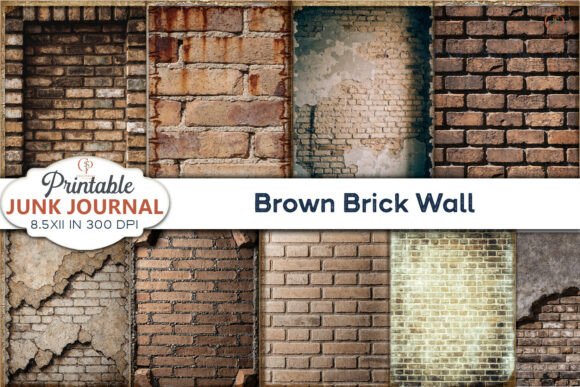
There is a specific kind of beauty found in the city’s grit—the way light catches on a weathered facade, the stories embedded in crumbling mortar, and the rich, earthy tones of an exposed Brown Brick Wall. For creatives, designers, and paper artists, this urban aesthetic is often hard to capture authentically. Enter the Brown Brick Wall Junk Journal Pages, a set of design assets that brings that tactile, industrial atmosphere directly into your creative workspace. This isn't just a collection of images; it is a toolkit for building depth and narrative in your projects.
The Visual Anatomy of Industrial Grit
When you first encounter this collection, you will notice the distinct personality of the textures. These pages are designed to evoke the feeling of vintage urban decay without looking messy or unintentional. The color palette relies on a range of terracotta, charcoal, and sandy beige, creating a warm but grounded foundation for any layout. This makes it an incredibly versatile background for layering other elements, much like a serif font provides structure to a body of text, these brick textures provide structural integrity to a visual composition.
The high-resolution nature of these files is critical. In editorial design or packaging design, the difference between a professional look and an amateur one often lies in the quality of the assets. At 300 DPI, these pages hold up under scrutiny, allowing you to zoom in on the cracks and pores of the brick without pixelation. This level of detail is essential for creating immersive junk journals where the reader feels they can touch the wall, or for scrapbooking layouts that need to anchor busy photographs.
Strategic Applications: Beyond the Craft Table
While these pages are perfect for DIY creative projects and paper crafts, their utility extends far beyond personal hobbyist work. If you are an entrepreneur or a content creator, understanding how to use texture is a key part of building a brand identity. A rough, brick texture suggests stability, history, and raw honesty. It is the perfect background for brands that want to appear grounded and authentic rather than glossy and artificial.
Consider the following practical applications:
- Social Media Graphics: Use the Brown Brick Wall as a background for quotes or announcements. It provides high contrast for white or cream typography, making your text pop on a busy feed. It works exceptionally well with handwritten fonts or bold sans serif fonts.
- Planner Decoration: For the bullet journaling community, these pages offer a break from pastels. They provide a "grunge" aesthetic that pairs well with metallic pens and washi tape.
- Card Making: Create masculine or industrial-themed greeting cards. The texture eliminates the need for heavy embellishment; the background does the heavy lifting.
- Collage Art: Digital collage artists can use these as the "canvas," layering vintage ephemera and modern graphics to create complex, modern typography compositions.
Visual Hierarchy and Audience Perception
In design, texture influences how a viewer perceives a message. A smooth, flat background suggests modernity and efficiency—think of a tech startup's website. In contrast, the Brown Brick Wall suggests permanence and craftsmanship. When you use these pages in your work, you are implicitly telling your audience that the content is substantial.
This is where the concept of visual hierarchy comes into play. If you are designing a cover for a junk journal or a poster, the brick texture acts as a supporting character. It should not overwhelm the main message. Because the texture is organic and complex, it pairs best with clean, legible typography. A heavy display font works well for headlines, while a simple sans serif ensures readability for smaller text blocks. Avoid using overly ornate script fonts over the busy texture, as the intricate details of the letters may get lost in the mortar lines of the brick.
Integrating Texture into Your Workflow
The files are delivered as high-quality JPEGs sized at 8.5 x 11 inches, making them immediately compatible with standard printing setups. Whether you are printing at home or sending them to a professional printer, the dimensions are optimized for hassle-free production. For digital designers, these files serve as excellent background layers in Photoshop or Procreate.
When evaluating project fit, ask yourself about the emotional tone of your piece. Are you creating a brand for a coffee shop, a construction company, or a streetwear line? The Brown Brick Wall fits perfectly. Are you designing a wedding invitation? Perhaps use it sparingly as a border element rather than a full bleed.
One of the most effective ways to use these assets is in mixed media projects. You can print the pages on different paper stocks—matte for a dusty, dry look, or glossy to highlight the sheen of wet brick. This flexibility allows you to adapt the asset to various creative needs, from logo design backgrounds to web design hero sections.
Ultimately, these pages are about adding character. In a digital world that often feels sterile, the raw, tactile nature of a brick wall brings a human element to your work. It is a reminder that great design often borrows from the real world.