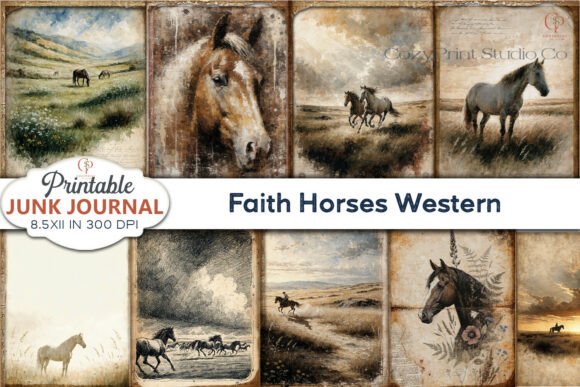
Western Charm for Your Creative Projects
The aesthetic of the American West carries a specific weight—rugged individualism, wide-open spaces, and a connection to tradition. When you bring that feeling into paper crafts, you are doing more than just gluing pages together; you are telling a story. The Faith Horses Western Junk Journal Pages offer a distinct visual foundation for this type of storytelling. This digital kit focuses on the intersection of equestrian beauty and rustic western styling, providing ten unique JPEG files designed to serve as the backbone for your next journal or scrapbook.
As a designer, I find that themed assets like these are most effective when they balance specificity with versatility. These pages are not just generic brown paper textures; they are curated compositions. They feature the visual weight of western motifs—likely incorporating leather textures, horseshoe imagery, and distressed typography—paired with the soft, emotional resonance of "faith" themes. This blend allows for a project that feels grounded and earthy yet deeply personal. Whether you are a hobbyist documenting a trail ride or a small business owner creating packaging for artisanal goods, understanding the personality of these pages is the first step to using them effectively.
The Visual Language of Rustic Western Design
To use the Faith Horses Western Junk Journal Pages effectively, you have to look beyond the subject matter and analyze the style. Western design is characterized by a specific color palette: weathered browns, dusty tans, deep reds, and often touches of turquoise or gold. It relies heavily on texture. You want to see the grain of the leather and the fibers of the paper.
These pages are designed at 300 DPI with an 8.5 x 11-inch footprint. In the world of print design, that high resolution is non-negotiable. It ensures that when you print these files for collage art or junk journals, the details remain crisp. There is a tactile quality that digital files try to mimic; the best design assets succeed by simulating the imperfections of real-world materials. You are looking for "grit" here—the visual equivalent of a worn saddle or an old barn door.
When working with this style, consider how the elements interact with your text. If you are using these pages as a background for journaling, the visual "noise" of the western texture should not overpower your handwriting or the typeface you choose for digital overlays. The appeal lies in the layering. A high-quality background allows you to place ephemera—tickets, photos, pressed flowers—on top without the layout feeling cluttered.
Strategic Applications for Designers and Makers
The utility of the Faith Horses Western Junk Journal Pages extends far beyond personal scrapbooking. For creative professionals, these assets offer a shortcut to a specific brand identity. If you are a marketer or entrepreneur in the equine, outdoor, or lifestyle sectors, these visuals speak a language your audience already understands.
Here are practical ways to integrate these assets into your workflow:
- Editorial Design and Zines: Use the pages as chapter dividers or full-bleed backgrounds in a digital magazine. The western aesthetic works beautifully for interviews with ranchers, features on rural living, or poetry collections.
- Packaging Design: If you sell handmade candles, leather goods, or spices, the texture from these pages can be printed on cardstock to create sleeve wraps or hang tags. It adds an immediate layer of perceived value and artisanal quality.
- Social Media Graphics: In a feed dominated by sleek, minimalist sans serif font aesthetics, a textured, western background stops the scroll. Use these pages as a base for quote graphics or sale announcements to differentiate your brand.
- Planner Decoration: For the hobbyist, printing these pages at half-size (to fit A5 planners) allows for custom dashboard dividers that coordinate with a western-themed stationery collection.
The key is to treat these files as raw materials. Just as a carpenter takes wood and shapes it, you take these digital files and crop, blend, and overlay them to fit your specific needs.
Typography and Pairing Strategies
A background is only as good as the text that sits on top of it. When working with the Faith Horses Western Junk Journal Pages, your choice of font will make or break the design. Because the background is likely textured and detailed, you need a typeface with high legibility.
Avoid overly ornate script fonts for body text. While a handwritten font might seem like a natural fit for a journal, it can become unreadable if the loops and swirls get lost in the texture of the horse imagery. Instead, look for a sturdy serif font for headers. A serif with a bit of a "slab" quality anchors the design, matching the sturdiness of the western theme.
For body text or journaling prompts, a clean sans serif font often provides the best contrast. The modern simplicity of a sans serif against a rustic, vintage background creates a pleasing tension. This is a core principle of modern typography: mixing the old with the new to create visual interest. If you are creating a logo design to accompany your project, ensure the lettering has enough weight to stand out against the busy patterns of the journal pages.
Print Production and Material Considerations
Since these are ready to print digital files, the final output depends heavily on your equipment and materials. To get the most out of the Faith Horses Western Junk Journal Pages, do not just print them on standard copy paper. The design calls for substance.
Consider using a heavier cardstock, perhaps 80lb or 100lb cover weight. This adds rigidity, which is essential for junk journals where pages are often layered with glue, tape, and heavy ephemera. If you are using these for card making, a matte finish usually suits the western theme better than a high gloss, as gloss can fight with the intended "aged" look of the graphics.
Also, remember that this is an instant download. You have the flexibility to experiment. Print one sheet first to test your color calibration. Western palettes often rely on subtle earth tones; if your printer is set to "vivid" or "auto," it might oversaturate the reds or yellows, making the design look artificial rather than rustic.
Ultimately, the Faith Horses Western Junk Journal Pages are a versatile set of design assets